
Data is everywhere.
From streaming platforms and online shopping to healthcare systems and financial services, organizations rely on data to make decisions every day. But raw data alone is not enough. Companies need professionals who can organize, analyze, and translate that information into meaningful insights.
That is where data analysts come in.
For students, recent graduates, and early-career professionals exploring the tech industry, data analytics has become one of the most attractive career paths because of its growing demand, versatility, and strong career opportunities.
But many beginners quickly encounter another challenge:
Which tools should I learn first?
The world of data analytics includes many platforms, languages, and technologies, which can feel overwhelming at the beginning. The good news is that aspiring data analysts do not need to master everything at once.
Instead, understanding the most used tools and what they are used for can help you build a solid foundation and focus on your learning more effectively.
Why Tools Matter in Data Analytics
Data analysts work with information to help organizations answer questions, identify trends, and make better decisions.
For example, a company may want to know:
- Which products are performing best?
- Why did sales drop in a specific region?
- How do customers interact with their services?
- Which operational processes need improvement?
To answer these questions, analysts use tools that help them collect, organize, visualize, and interpret data.
Each tool serves a different purpose. Some help retrieve information from databases, while others create dashboards or automate analysis tasks.
Learning these tools not only strengthens technical skills but also improves job readiness for real-world business environments.
That is why structured learning programs are becoming increasingly valuable for aspiring analysts.
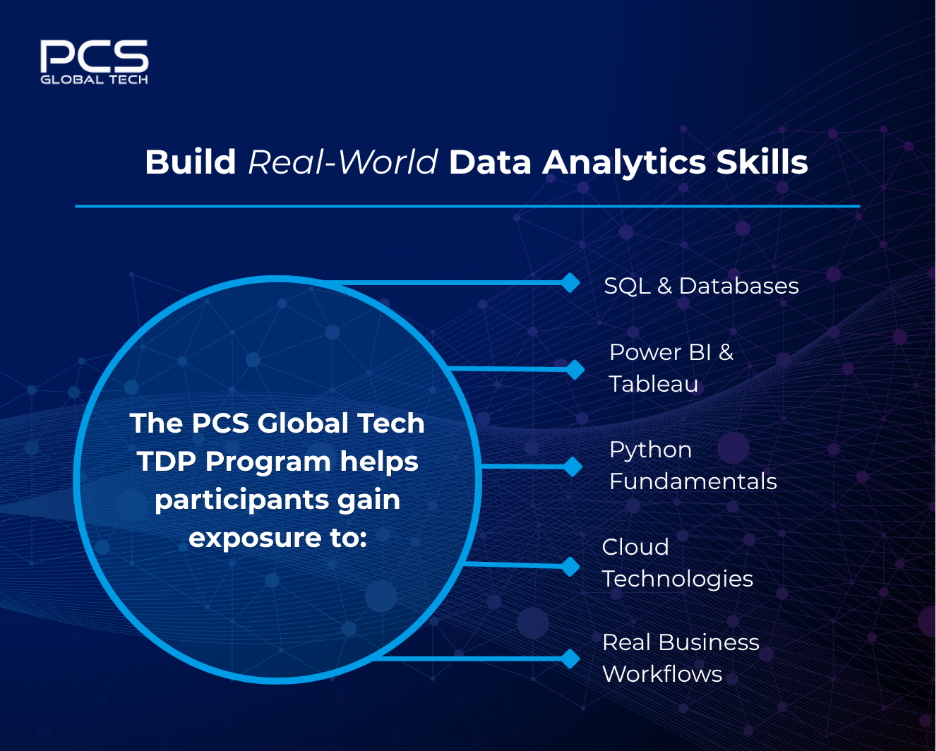
The Talent Development Program (TDP) at PCS Global Tech helps participants gain exposure to industry-relevant technologies and firsthand learning experiences that reflect the tools and workflows commonly used in modern data environments.
Rather than focusing only on theory, programs like TDP help bridge the gap between academic learning and practical workplace skills.
SQL: The Foundation of Data Analysis
One of the most important tools every aspiring data analyst should learn is SQL.
SQL, or Structured Query Language, is used to work with databases. Since most organizations store substantial amounts of information in databases, SQL has become one of the most in-demand skills across analytics and business intelligence roles.
SQL allows analysts to:
- Retrieve data.
- Filter information.
- Organize datasets.
- Combine multiple data sources.
- Create reports.
For example, a data analyst may use SQL to identify sales trends, analyze customer behavior, or generate operational reports.
SQL is often considered one of the best starting points for beginners because it is practical, widely used, and easier to learn compared to many programming languages.
Excel: Still One of the Most Used Business Tools
Despite the growth of advanced analytics platforms, Excel remains one of the most widely used tools in business environments.
Many organizations still rely heavily on spreadsheets for reporting, budgeting, analysis, and operational tracking.
Excel helps analysts:
- Organize data.
- Create charts and reports.
- Perform calculations.
- Identify trends.
- Build simple dashboards.
For beginners, Excel is valuable because it helps build analytical thinking and familiarity with working with structured information.
Even experienced analysts continue using Excel regularly alongside more advanced technologies.
Power BI and Tableau: Turning Data into Visual Insights
Data analysis is not only about finding insights, but also about communicating them clearly.
That is where visualization tools like Power BI and Tableau become important.
These platforms help analysts create dashboards, charts, and visual reports that make complex information easier to understand.
Instead of reviewing thousands of rows in spreadsheets, decision-makers can quickly identify patterns through interactive visualizations.
For example, dashboards can help organizations monitor:
- Sales performance.
- Customer behavior.
- Financial trends.
- Operational efficiency.
- Marketing performance.
Visualization skills are highly valuable because businesses increasingly rely on data storytelling to support decision-making.
PCS Global Tech’s TDP Program introduces participants to technologies such as Power BI and Tableau through structured learning experiences designed around real-world industry use cases.
This type of exposure helps early-career professionals gain familiarity with tools that employers actively use in modern analytics environments.
Python: Expanding Analytical Capabilities
As data environments continue to grow, many analysts also learn Python to expand their technical capabilities.
Python is a programming language commonly used for:
- Data analysis.
- Automation.
- Data cleaning.
- Advanced reporting.
- Artificial intelligence.
- Machine learning.
While SQL focuses on databases, Python allows analysts to automate repetitive tasks and work with larger or more complex datasets.
For beginners, Python may feel more challenging initially because it introduces broader programming concepts. However, it has become increasingly valuable in modern analytics roles due to its flexibility.
Many analysts begin with SQL and visualization tools before gradually learning Python as they grow professionally.
Cloud Platforms Are Becoming Increasingly Important
As organizations continue moving their operations to cloud environments, cloud technologies are becoming more relevant for data professionals.
Platforms like Microsoft Azure help organizations store, process, and manage data more efficiently.
While aspiring analysts do not necessarily need deep cloud expertise immediately, understanding basic cloud concepts can become a major advantage over time.
Cloud technologies support:
- Large-scale data storage.
- Data integration.
- Analytics workflows.
- Collaboration across teams.
- Scalable reporting environments.
Because modern businesses increasingly rely on cloud-based systems, many career development programs now include exposure to cloud technologies as part of technical training.
Programs like PCS Global Tech’s TDP Program help participants gain familiarity with tools and platforms commonly used in real business environments, including Azure and modern data workflows.
Soft Skills Matter Alongside Technical Tools
While learning technical tools is important, successful data analysts also need strong soft skills.
Analysts regularly communicate findings to managers, clients, and stakeholders who may not have technical backgrounds.
That means communication, problem-solving, and collaboration are essential parts of the role.
Strong analysts know how to:
- Explain insights clearly.
- Ask effective questions.
- Collaborate with teams.
- Present findings confidently.
- Adapt to changing business needs.
This combination of technical and professional development helps candidates stand out in competitive job markets.
That is why structured learning environments that combine technical training with mentorship and professional preparation can be especially valuable for students and recent graduates.
Final Thoughts
Starting a career in data analytics can feel overwhelming at first, especially with so many tools and technologies available.
The good news is that aspiring analysts do not need to learn everything immediately. Building a solid foundation step by step is often the best approach.
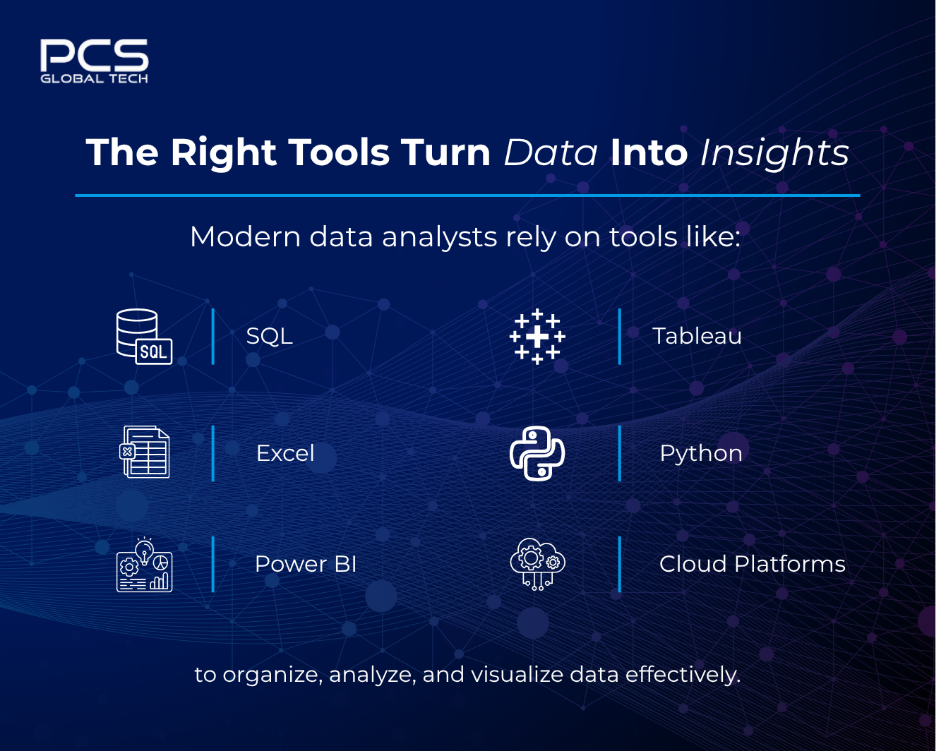
Tools like SQL, Excel, Power BI, Tableau, Python, and cloud platforms each play a key role in helping analysts organize, analyze, and communicate data effectively.
Over time, learning these tools can open doors to exciting opportunities in analytics, business intelligence, consulting, and technology.
Programs like PCS Global Tech’s Talent Development Program help early-career professionals strengthen these practical skills through firsthand learning, mentorship, and exposure to real-world technologies used across the industry.
Looking to accelerate your tech career after graduation? Apply now to the TDP Program.
Learn more through PCS Global Tech
