

For students, recent graduates and early-career professionals entering the tech industry, one question comes up constantly:
Should I learn SQL or Python first?
Both are highly valuable skills. Both are widely used across the tech industry. And both can open doors to careers in data analytics, software development, business intelligence, data engineering, and artificial intelligence.
But if you are just starting your career, choosing where to begin can feel overwhelming.
The good news is that there is no “wrong” choice. SQL and Python are complementary skills, not competing ones. The best option often depends on your goals, learning style, and the type of career you want to pursue.
Understanding the differences between them can help you make a smarter decision about where to start.
What Is SQL?
SQL stands for Structured Query Language.
It is a language used to interact with databases. Companies use databases to store massive amounts of information, including customer records, sales transactions, inventory data, financial information, and operational metrics.
SQL allows professionals to:
- Retrieve data.
- Filter information.
- Organize datasets.
- Create reports.
- Update records.
- Analyze trends.
In simple terms, SQL helps you “talk” to databases.
For example, a business analyst may use SQL to answer questions like:
- Which products sold the most last month?
- How many customers made repeat purchases?
- Which regions generated the highest revenue?
Because nearly every organization works with data, SQL has become one of the most in-demand skills across industries.
What is Python?
Python is a general-purpose programming language known for being beginner-friendly and highly versatile.
Unlike SQL, which is designed specifically for databases, Python can be used for many different tasks, including:
- Data analysis.
- Automation.
- Web development.
- Artificial intelligence.
- Machine learning.
- Software development.
- Data visualization.
Python is popular because its syntax is relatively simple and readable compared to many other programming languages.
For example, Python can help automate repetitive tasks, clean datasets, build applications, or even create AI models.
Its flexibility makes it one of the most valuable programming languages in today’s tech industry.
SQL vs Python: What Is the Main Difference?
The simplest way to understand the difference is this:
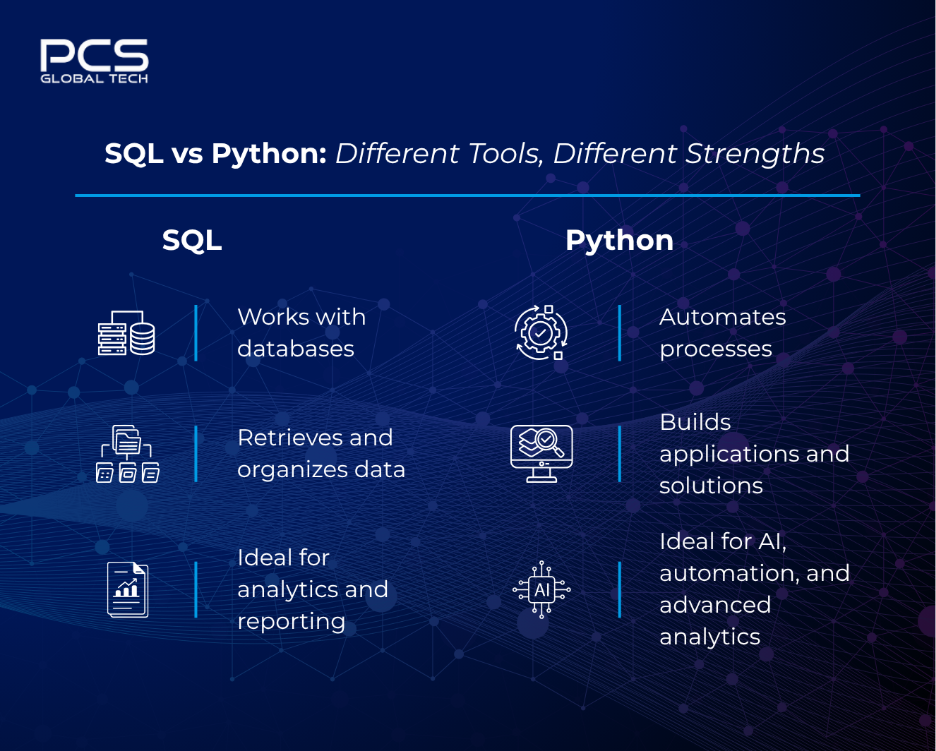
- SQL is primarily used to work with data stored in databases.
- Python is used to build, automate, analyze, and solve broader technical problems.
SQL is highly specialized. Python is highly flexible.
Think of SQL as a tool for accessing and organizing information, while Python is a tool for creating processes and solutions around that information.
In many real-world roles, professionals use both together.
For example:
- A data analyst may use SQL to retrieve data and Python to analyze it.
- A data engineer may use SQL to manage data pipelines and Python to automate workflows.
- A business intelligence consultant may use SQL for reporting and Python for advanced analytics.
That is why learning one often leads naturally into learning the other.
Which One Is Easier for Beginners?
For most beginners, SQL is usually easier to learn first. Why?
Because SQL focuses on a smaller set of concepts and follows a straightforward structure. Beginners can often start writing simple queries very quickly.
For example, SQL queries are often written in readable formats like:
- SELECT
- FROM
- WHERE
- ORDER BY
This makes SQL less intimidating for people who care completely new to tech or programming.
Python, on the other hand, introduces broader programming concepts such as:
- Variables
- Loops
- Functions
- Logic structures
- Error handling
While Python is considered beginner-friendly compared to many programming languages, it still requires more time and practice to fully understand.
That is why many early-career professionals start with SQL to build confidence before moving into Python.
Career Paths: Where Can Each Skill Take You?
Both SQL and Python can lead to strong career opportunities, but they are often associated with slightly different paths.
Careers That Commonly Use SQL
SQL is heavily used in:
- Data analytics
- Business intelligence
- Reporting
- Database administration
- Financial analysis
- Operations analysis
Common roles include:
- Data Analyst
- Business Intelligence Analyst
- Reporting Analyst
- Database Administrator
- BI Consultant
If you enjoy working with business insights, reporting, dashboards, and structured data, SQL is an excellent starting point.
Careers That Commonly Use Python
Python is commonly used in:
- Software development
- Data science
- Machine learning
- Automation
- Artificial intelligence
- Data engineering
Common roles include:
- Python Developer
- Data Scientist
- Machine Learning Engineer
- Automation Engineer
- Data Engineer
If you enjoy building applications, automating tasks, or working with AI and advanced analytics, Python may align more closely with your interests.
What Does Industry Demand Look Like?
The demand for both SQL and Python remain extremely strong.
Companies today rely heavily on data-driven decision-making, which means organizations need professionals who can work with data efficiently.
SQL remains one of the most requested skills in analytics and business intelligence roles because databases are still the foundation of most business operations.
At the same time, Python continues to grow rapidly due to the expansion of AI, automation, cloud technologies, and advanced analytics.
The reality is that modern tech professionals often benefit from learning both.
This is one reason why structured career programs focus on building well-rounded technical foundations instead of teaching isolated skills.
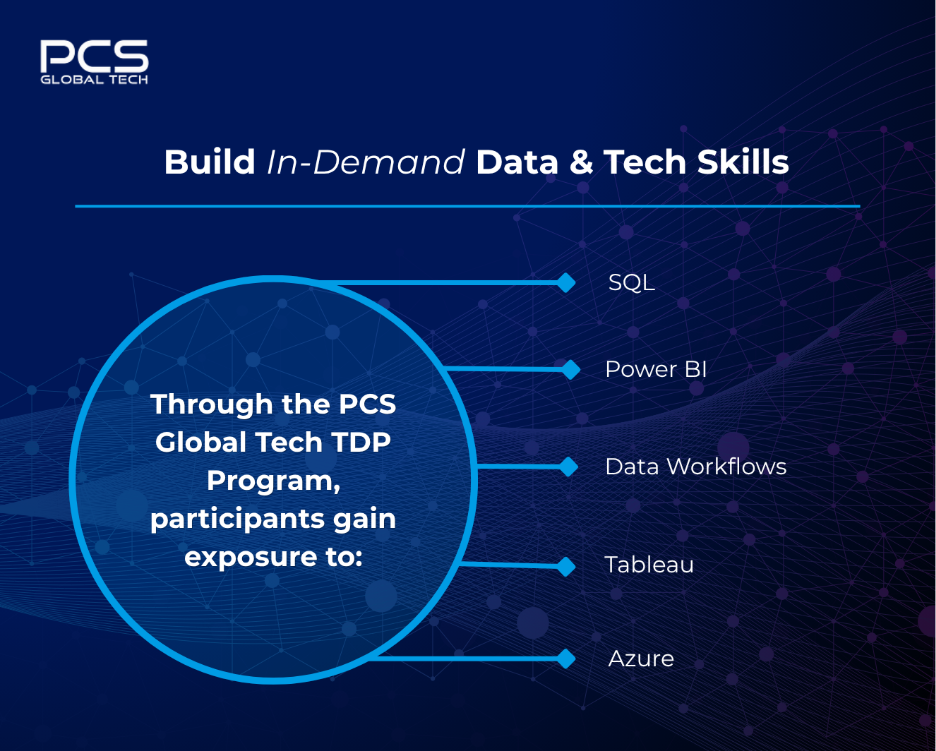
The Talent Development Program (TDP) at PCS Global Tech helps participants strengthen practical, in-demand technical skills through firsthand learning experiences and industry-focused training. Participants gain exposure to technologies commonly used in modern business environments, including SQL, Power BI, Azure, Tableau, and data-focused workflows.
The program is designed to help STEM graduates and early-career professionals bridge the gap between academic learning and real-world technical environments.
So… Which One Should You Learn First?
If your goal is to enter the tech industry quickly and build a strong data foundation, SQL is often the best place to start.
It is easier for beginners, highly practical, and immediately useful in many entry-level roles.
Once you feel comfortable working with data and databases, learning Python becomes much easier because you already understand how data is structured and used.
However, if your long-term goal is software development, automation, AI, or machine learning, Python may become your primary focus over time.
The important thing is not choosing one forever. The real goal is to build a learning path that helps you grow progressively.
Final Thoughts
SQL and Python are both valuable skills that can open doors to exciting careers in technology.
SQL helps professionals work directly with data and business information, while Python provides the flexibility to automate, analyze, and build advanced solutions.
For beginners, SQL is often an easier and more approachable starting point. Python expands opportunities further as technical confidence grows.
The strongest tech professionals often combine both skills over time.
Programs like PCS Global Tech’s Talent Development Program help early-career professionals build these practical technical foundations through structured training, mentorship, and firsthand learning experiences designed around real industry needs.
Looking to accelerate your tech career after graduation? Apply now to the TDP Program.
Learn more through PCS Global Tech
